MARScone – nowy algorytm przyspieszający analizę form stożkowych na Marsie – publikacja w SoftwareX
MARScone – nowy algorytm przyspieszający analizę stożków na Marsie – publikacja w SoftwareX
MARScone – a new algorithm accelerating the analysis of pitted cones on Mars – a new publication in SoftwareX
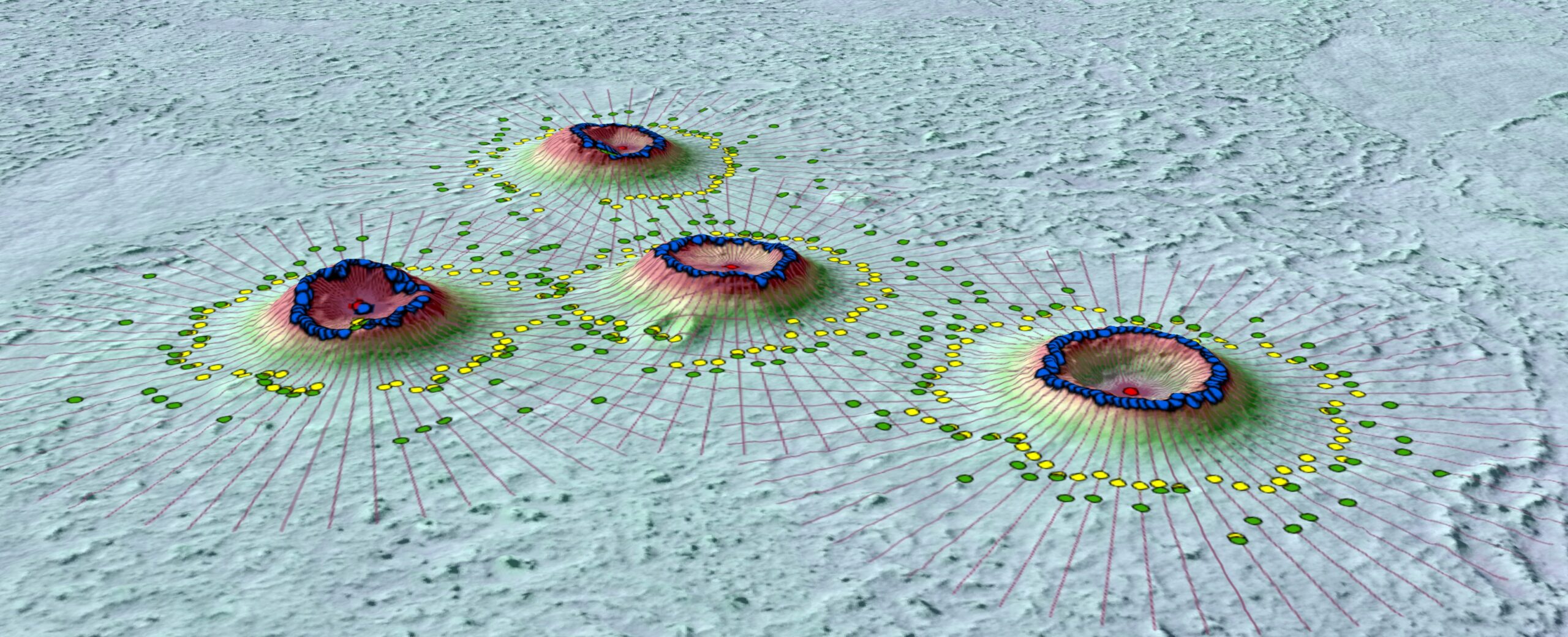
W ramach współpracy naukowej z Uniwersytetem Szczecińskim zespół projektu MARIVEL opracował nowatorski algorytm MARScone, przeznaczony do analizy morfometrii form stożkowych na powierzchni Marsa. To istotny krok w kierunku automatyzacji badań geomorfologicznych Czerwonej Planety.
Formy stożkowe, takie jak stożki wulkaniczne, błotne czy struktury związane z procesami sublimacyjnymi, stanowią cenne źródło informacji o przeszłości geologicznej Marsa. Ich dokładna klasyfikacja oraz interpretacja genezy wymagają szczegółowych analiz morfometrycznych — obejmujących m.in. wysokość, nachylenie stoków, średnicę podstawy czy proporcje geometryczne.
Dotychczas proces ten był czasochłonny i w dużej mierze oparty na pracy manualnej lub półautomatycznych narzędziach. Algorytm MARScone znacząco usprawnia ten etap badań, umożliwiając szybkie i zautomatyzowane przetwarzanie dużych zbiorów danych topograficznych. Dzięki zastosowaniu zaawansowanych metod analizy przestrzennej i przetwarzania danych możliwe jest nie tylko przyspieszenie pomiarów, ale również zwiększenie ich precyzji i powtarzalności.
W praktyce oznacza to, że naukowcy mogą analizować znacznie większe obszary Marsa w krótszym czasie, co przekłada się na bardziej kompleksowe podejście do badań powierzchni planety. Automatyzacja analiz morfometrycznych otwiera również drogę do odkrywania nowych zależności i wzorców, które wcześniej mogły pozostawać niezauważone.
Rozwój algorytmu MARScone wpisuje się w szerszy trend wykorzystania nowoczesnych narzędzi obliczeniowych w planetologii. Efekty tej współpracy nie tylko wzmacniają potencjał badawczy projektu MARIVEL, ale również przyczyniają się do lepszego zrozumienia procesów kształtujących powierzchnię Marsa — a tym samym historii tej fascynującej planety.
MARScone – a new algorithm accelerating the analysis of pitted cones on Mars – a new publication in SoftwareX
As part of a scientific collaboration with the University of Szczecin, the MARIVEL project team has developed an innovative algorithm called MARScone, designed to analyze the morphometry of conical features on the surface of Mars. This is a significant step toward automating geomorphological research on the Red Planet.
Conical features, such as volcanic cones, mud cones, or structures associated with sublimation processes, are a valuable source of information about Mars’ geological past. Their accurate classification and interpretation of their origin require detailed morphometric analyses—including, among other things, height, slope angle, base diameter, and geometric proportions.
Until now, this process has been time-consuming and largely based on manual labor or semi-automated tools. The MARScone algorithm significantly streamlines this stage of research, enabling fast and automated processing of large topographic datasets. Thanks to the use of advanced methods of spatial analysis and data processing, it is possible not only to accelerate measurements but also to increase their precision and repeatability.
In practice, this means that scientists can analyze much larger areas of Mars in less time, which translates into a more comprehensive approach to studying the planet’s surface. The automation of morphometric analyses also paves the way for discovering new relationships and patterns that may have previously gone unnoticed.
The development of the MARScone algorithm is part of a broader trend toward the use of modern computational tools in planetary science. The results of this collaboration not only strengthen the research potential of the MARIVEL project but also contribute to a better understanding of the processes shaping the surface of Mars—and thus the history of this fascinating planet.